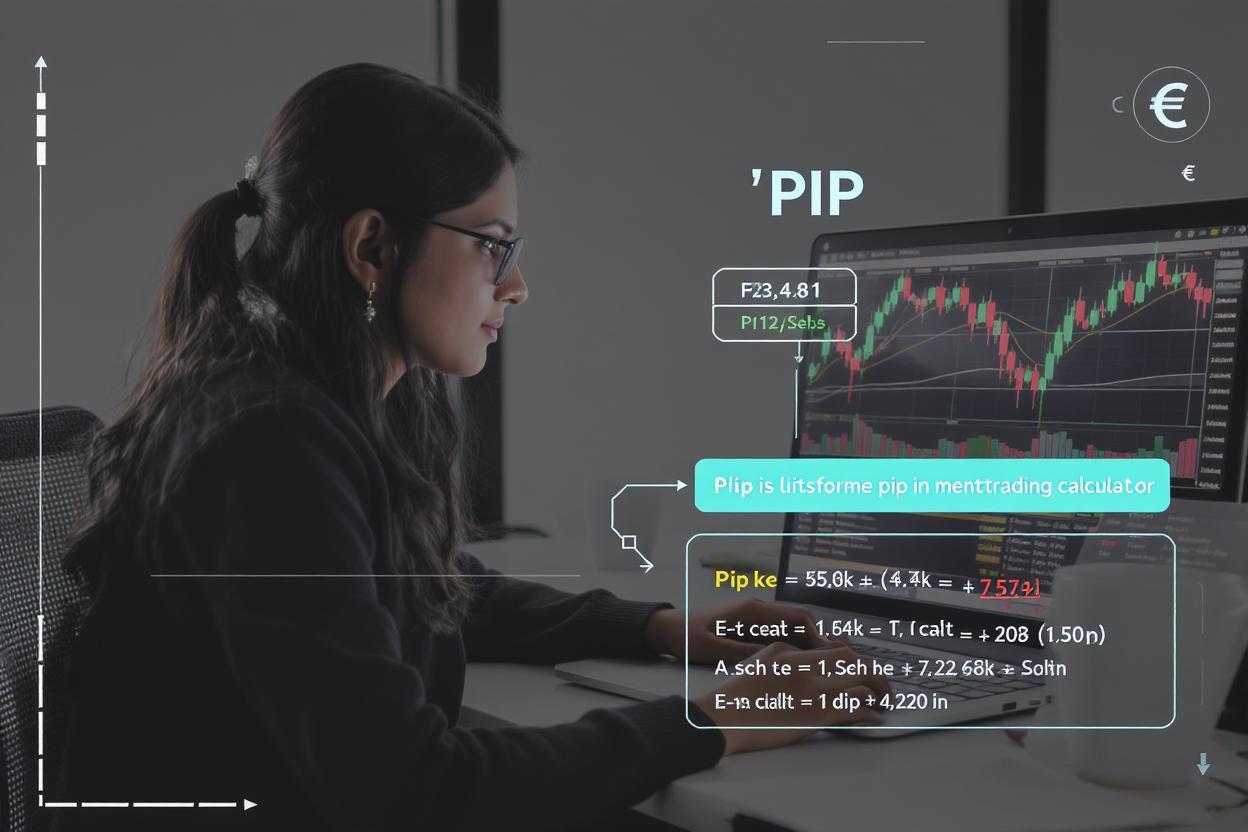
What is a Pip in Forex Trading? | Complete Guide for Beginners | TradeStocksPro What is a Pip in Forex Trading? The Complete Beginner's Guide By Aryan Sharma Updated: June 29, 2025 8 min read Understanding pips is fundamental to successful Forex trading If you're new to Forex trading, one of the first terms you'll encounter is "pip." This tiny measurement unit plays a massive role in calculating profits, losses, and risk management in currency trading. In this comprehensive guide, we'll explain everything you need to know about pips in Forex trading, from basic definitions to advanced calculations and trading strategies. Key Takeaways A pip (percentage in point) is the smallest price movement in Forex trading Most currency pairs are quoted to 4 decimal places (0.0001 = 1 pip) Pip value depends on the currency pair, trade size, and exchange rate Understanding pips is crucial for calculating profits, losses, and risk Pipettes (fractional pips) provide more precise pricing (0.00001) What Exactly is a Pip in Forex Trading? A pip, which stands for "percentage in point" or "price interest point," represents the smallest incremental price movement a currency pair can make. For most currency pairs, this is equivalent to a one-digit movement in the fourth decimal place (0.0001). Example: If the EUR/USD pair moves from 1.1050 to 1.1051, that's a 1 pip increase. Similarly, if it drops from 1.1050 to 1.1049, that's a 1 pip decrease. The exception to this rule is currency pairs involving the Japanese Yen (JPY), where a pip is represented by a one-digit movement in the second decimal place (0.01). Currency Pair Pip Location Example 1 Pip Movement EUR/USD, GBP/USD, AUD/USD 4th decimal 1.1050 → 1.1051 0.0001 USD/JPY, EUR/JPY, GBP/JPY 2nd decimal 110.50 → 110.51 0.01 What About Pipettes? With the advancement of trading technology, many brokers now quote prices to an extra decimal place, introducing the concept of pipettes. A pipette is one-tenth of a pip (0.00001 for most pairs, 0.001 for JPY pairs). While pipettes allow for more precise pricing, pips remain the standard unit for calculating profits and losses. Why Pips Matter in Forex Trading Understanding pips is fundamental to Forex trading for several reasons: Importance of Pips Profit/Loss Calculation: Pips help traders quantify their gains and losses Risk Management: Stop-loss and take-profit levels are set in pips Position Sizing: Pip value helps determine appropriate trade sizes Performance Measurement: Traders often track their success in pips gained Spread Measurement: The cost of trading is often measured in pips How to Calculate Pip Value The monetary value of a pip depends on three factors: The currency pair being traded The size of the trade (lot size) The current exchange rate Standard Pip Value Formula For currency pairs where USD is the quote currency (second currency): Pip Value = (0.0001 / Exchange Rate) × Lot Size Example Calculation Let's calculate the pip value for a standard lot (100,000 units) of EUR/USD at an exchange rate of 1.1050: (0.0001 / 1.1050) × 100,000 = $9.05 per pip This means each pip movement in this trade is worth approximately $9.05. Pip Value for JPY Pairs For JPY pairs, the formula adjusts for the different pip location: Pip Value = (0.01 / Exchange Rate) × Lot Size Example Calculation Calculating pip value for a standard lot of USD/JPY at 110.50: (0.01 / 110.50) × 100,000 = $9.05 per pip Quick Reference: Pip Values for Different Lot Sizes Lot Size Units Pip Value (EUR/USD at 1.1050) Pip Value (USD/JPY at 110.50) Standard Lot 100,000 $9.05 $9.05 Mini Lot 10,000 $0.90 $0.90 Micro Lot 1,000 $0.09 $0.09 Nano Lot 100 $0.009 $0.009 Calculating Profits and Losses Using Pips Once you understand pip value, calculating potential profits or losses becomes straightforward: Profit/Loss = (Number of Pips Gained or Lost) × (Pip Value) Trading Example Let's say you buy 1 standard lot of EUR/USD at 1.1050 and sell it at 1.1100: Price movement: 1.1100 - 1.1050 = 0.0050 (50 pips) Pip value: $9.05 (from our earlier calculation) Profit: 50 pips × $9.05 = $452.50 Conversely, if you sold at 1.1000 instead, you would have lost: 50 pips × $9.05 = $452.50 Pips in Risk Management Professional traders use pips to manage risk effectively. Here's how: 1. Setting Stop-Loss Orders A stop-loss is an order to close a trade at a predetermined price level to limit losses. Traders typically set stop-losses a certain number of pips away from their entry price. Example If you buy EUR/USD at 1.1050 and set a 30-pip stop-loss, your stop-loss price would be 1.1020 (1.1050 - 0.0030). 2. Calculating Risk Per Trade Most risk management strategies recommend risking only 1-2% of your account per trade. Pips help you calculate appropriate position sizes. Risk Calculation Example Account balance: $10,000 Risk per trade: 1% ($100) Stop-loss: 30 pips Pip value needed: $100 / 30 pips = $3.33 per pip To achieve this pip value, you would need to trade approximately 0.37 lots (micro lots) of EUR/USD at 1.1050. Pips and Spreads The spread is the difference between the bid (sell) and ask (buy) price, typically measured in pips. It represents the broker's commission and the cost of entering a trade. Spread Example If EUR/USD is quoted as 1.1050 (bid) / 1.1052 (ask), the spread is 2 pips (1.1052 - 1.1050 = 0.0002). Lower spreads generally mean lower trading costs. Major currency pairs like EUR/USD typically have tighter spreads than exotic pairs. Practical Tips for Trading with Pips Pro Tips for Pip Trading Use a pip calculator: Many trading platforms and websites offer free pip calculators to simplify your calculations. Understand your broker's pip conventions: Some brokers quote fractional pips (pipettes). Consider pip value when choosing pairs: Higher value pairs may require smaller position sizes. Factor in spreads: A trade needs to overcome the spread before becoming profitable. Monitor pip volatility: Some currency pairs move more pips per day than others. Frequently Asked Questions About Pips What's the difference between pips and points? While the terms are sometimes used interchangeably, there's a technical difference. A pip is typically the fourth decimal place (0.0001) for most pairs, while a point is the smallest price movement a currency can make, which could be a pipette (0.00001). In practice, many traders use "points" to refer to pips. Do all Forex pairs use the same pip value? No, pip values vary depending on the currency pair and the current exchange rate. JPY pairs have different pip locations (second decimal place), and the value changes based on the exchange rate fluctuations. How many pips do currency pairs typically move in a day? This varies significantly by pair and market conditions. Major pairs like EUR/USD might average 50-100 pips per day, while more volatile pairs like GBP/JPY could move 150+ pips. During major news events, movements can be much larger. Is it better to trade pairs with high or low pip values? Neither is inherently better—it depends on your trading strategy and risk tolerance. Higher pip values mean each pip movement affects your account more, requiring smaller position sizes. Lower pip values allow for larger position sizes with the same risk. How do I calculate pip value when my account isn't in USD? You'll need to convert the USD pip value to your account currency. For example, if you have a EUR account and the USD pip value is $10, with EUR/USD at 1.1000, the EUR pip value would be $10 ÷ 1.1000 = €9.09. Ready to Master Forex Trading? Understanding pips is just the beginning of your Forex trading journey. Join our comprehensive Forex trading course to learn professional strategies, risk management techniques, and how to build a profitable trading plan. Explore Forex Courses Sign Up for Free Aryan Sharma Aryan is a professional Forex trader and educator with over 10 years of market experience. As the founder of TradeStocksPro, he has helped thousands of students master currency trading through his practical, no-nonsense approach to market education. Continue Your Forex Education Expand your trading knowledge with these related articles: Forex Trading 101: A Beginner's Guide to the Currency Market Learn the fundamentals of currency trading, market participants, and what moves Forex prices in this comprehensive beginner's guide. Read More 5 Simple Forex Strategies for Beginners to Start Earning Discover five easy-to-implement Forex trading strategies that beginners can use to start making consistent profits in the currency markets. Read More Mastering Forex Chart Patterns: The Complete Guide Learn how to identify and trade the most profitable chart patterns in Forex trading, with real-world examples and trading strategies. Read More TradeStocksPro Your premier destination for professional stock and Forex market education. Learn from experienced traders and take your skills to the next level. Quick Links Home Courses Blog Instructors Contact Us Resources Chart Patterns Forex Patterns Free Forex PDFs Learn Forex Free Stock Market Learning Legal Terms of Service Privacy Policy Disclaimer SEBI Registered LRS Guidelines Our Partners © 2025 TradeStocksPro. All Rights Reserved. | Contact Us | Password Recovery Disclaimer: Trading stocks, Forex, and other financial instruments carries a high level of risk and may not be suitable for all investors.